⚠️ Important Note:
The information on this page provides a general overview of the procedure. The exact instructions and experience may differ depending on the hospital or institution where your test is performed. If there is any difference between what is written here and what your medical team has told you, always follow the guidance provided by the team performing your procedure.
- What is this test or procedure?
- Why is it done?
- What should I expect on the day of the test?
- What will happen during the procedure?
- Possible Outcomes After the Angiogram
- What should I tell my doctor before the test?
- ⚠️ Are there any risks?
- What happens after the test?
- How to prepare
- Frequently Asked Questions
- 🔗 Learn More
What is this test or procedure?
Coronary angiography is a test that uses dye and X-rays to look at the blood vessels that supply your heart. It helps your doctor find blockages or narrowing in the coronary arteries.
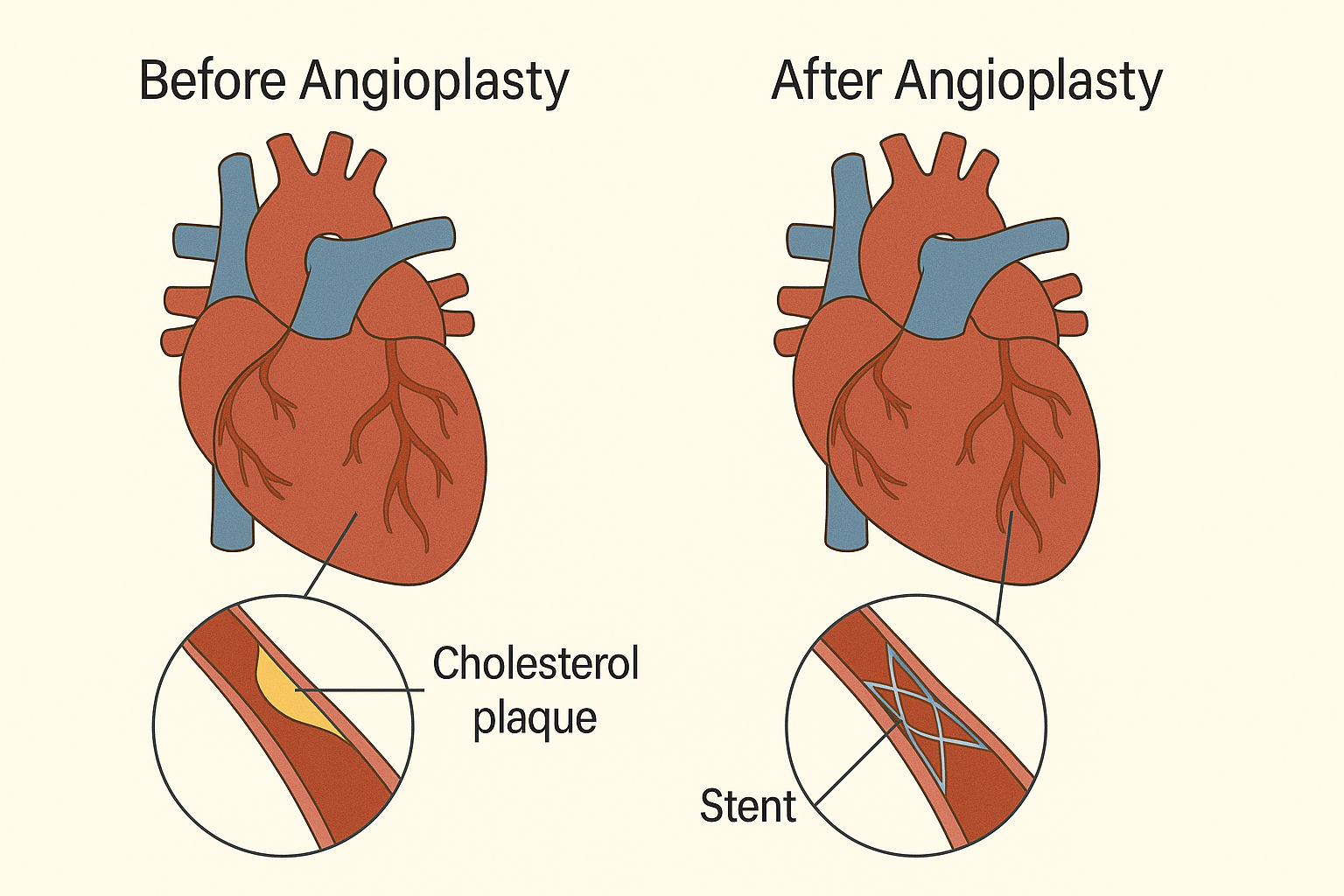
If a blockage is found, your doctor may perform a coronary angioplasty (also called percutaneous coronary intervention (PCI) or stenting) during the same procedure. This involves using a tiny balloon to open the artery and placing a small metal mesh tube (called a stent) to keep it open.
Why is it done?
Your doctor may recommend this test to:
- Investigate symptoms like chest pain, shortness of breath, or abnormal stress test results
- Assess the severity of coronary artery disease
- Guide treatment during or after a heart attack
- Evaluate heart function and blood flow before surgery
What should I expect on the day of the test?
Where will it take place?
In a specialized cardiac catheterization lab (cath lab) within a hospital.
Who will be in the room?
- An interventional cardiologist
- Nurses and cath lab technologists
- A sedation or monitoring nurse
What does the room look like?
- A large X-ray camera suspended over a procedure table
- Monitors displaying your heart rhythm and artery images
- Staff in scrubs, wearing masks and sterile gowns
How long does it take?
- The procedure usually takes 30 to 60 minutes
- If stents are placed or other procedures are performed, it may take longer
- Plan to be monitored for 4 to 6 hours afterward
What will happen during the procedure?
- You’ll be connected to monitors and given medication to relax.
- A catheter is inserted through your wrist or groin after numbing the area.
- Contrast dye is injected into the heart’s arteries while X-rays are taken.
- If a blockage is found, angioplasty and stenting may be performed right away.
- Afterward, the catheter is removed, and pressure is applied to stop bleeding.
Possible Outcomes After the Angiogram
After reviewing the angiogram, your cardiologist may find:
- Normal arteries: No coronary artery disease
- Mild CAD: No stents required; managed with medications and lifestyle
- Significant blockages: Stents placed during the same procedure
- Severe or multivessel disease: Surgery (coronary artery bypass) may be recommended
Your cardiologist will discuss the findings and next steps with you.
What should I tell my doctor before the test?
- If you have kidney disease, allergies to dye, or bleeding disorders
- If you are on blood thinners or diabetic medications
- If you are pregnant or think you may be
- A full list of your medications
⚠️ Are there any risks?
Coronary angiography and angioplasty are generally safe, but possible risks include:
- Bleeding or bruising at the wrist or groin
- Reaction to contrast dye (e.g. rash, kidney injury)
- Abnormal heart rhythms
- Damage to the artery (rare)
- Heart attack or stroke (very rare)
- Emergency cardiac surgery (very rare)
- Death (very rare but possible, especially in high-risk situations)
What happens after the test?
- You’ll be monitored for a few hours in a recovery area
- If done through the wrist, a tight band will be applied for a short time
- If done through the groin, you’ll need to lie flat for a few hours
- Most people go home the same day unless further treatment is needed
How to prepare
- Do not eat or drink for 6 hours before the test (unless otherwise specified)
- Take your regular medications unless told otherwise
- Bring a full list of your medications
- Arrange a ride home — you cannot drive yourself afterward
Frequently Asked Questions
🔹 What is the difference between an angiogram and angioplasty?
An angiogram is a diagnostic test that shows the blood vessels of the heart using dye and X-ray. Angioplasty (also called PCI or stenting) is a treatment done during the angiogram to open blocked arteries.
🔹 Do all blockages need to be opened?
No. Some blockages do not significantly restrict blood flow or cause symptoms. These can often be treated with medications and healthy lifestyle changes rather than a stent. Sometimes, the best treatment for narrowed or blocked arteries can be complicated and may need to be discussed further with you or with a multidisciplinary Heart Team.
🔹 What are the risks of putting in a stent?
Stents are generally safe, but potential risks include bleeding, allergic reactions to dye or stent material, blood clots forming in the stent (especially if medications are not taken properly), and rarely heart attack, stroke, or damage to the artery.
🔹 What is a bypass operation?
A coronary artery bypass graft (CABG) is a heart surgery that uses another blood vessel to reroute blood around one or more blocked coronary arteries. It’s typically recommended when several arteries are blocked or blockages are in difficult-to-treat locations.
🔹 Will I be awake during the procedure?
Yes. You’ll be given sedation to help you relax, but you’ll remain awake and able to follow instructions.
🔹 Will it hurt?
You may feel pressure at the catheter site and a warm sensation when the contrast dye is injected, but most patients find the test manageable and not painful.
🔹 Can I go home the same day?
Yes, most planned angiograms or angioplasties are done as same-day procedures. However, you may need to stay overnight if the test is done during a heart attack or if further care is needed.
🔹 When will I get the results?
Your cardiologist usually discusses the findings right after the procedure. In some cases, full results are reviewed in a follow-up visit.
🔗 Learn More
Sunnybrook Health Sciences Centre – Angiogram and Angioplasty: What to Expect
Detailed video showing steps involved in cardiac catheterization.
Sunnybrook Health Sciences Centre – My Angiogram Guide
Comprehensive guide for patients including pre-procedural instructions and post-procedural guidance.
 Dr. Sameer Kushwaha, MD FRCP(C)